
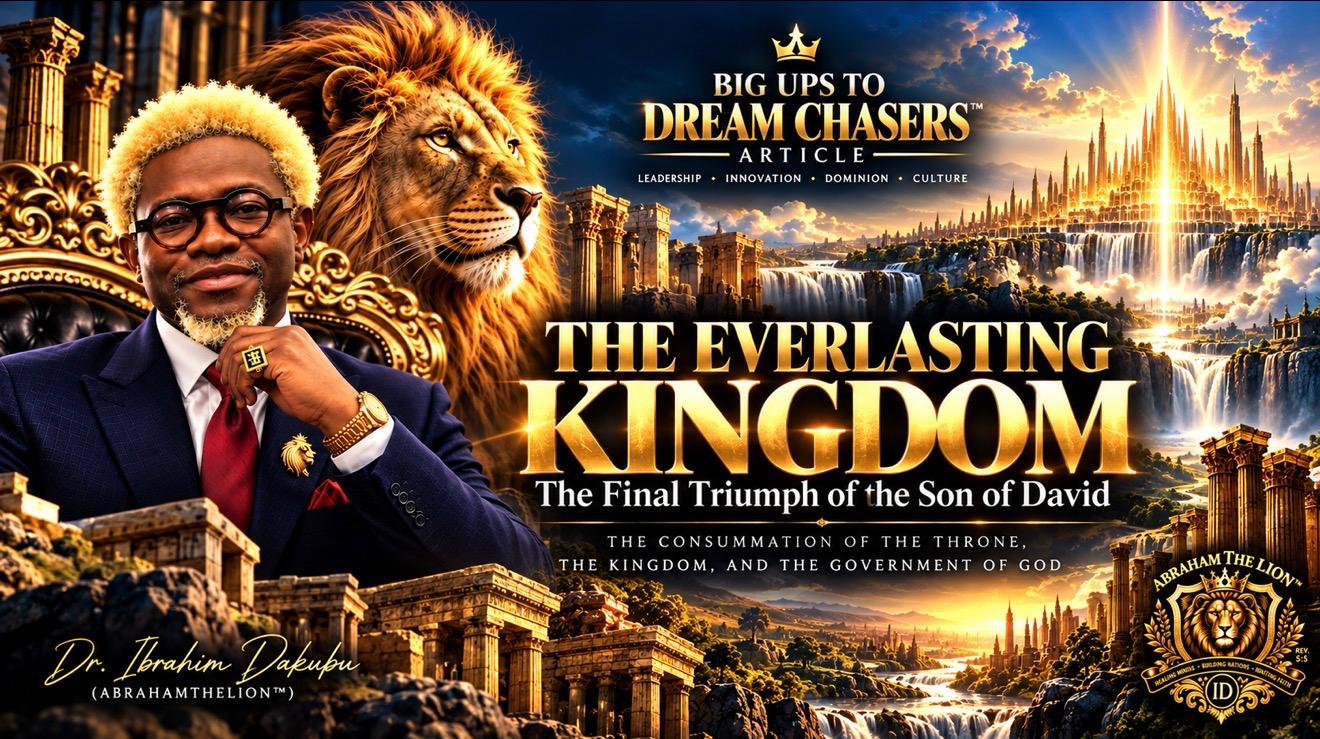
The Everlasting Kingdom and the Future of Divine Government
Companion study guide
The Everlasting Kingdom
The Final Triumph of the Son of David
A biblical study and leadership application guide with ten studies, reflection questions, practical actions, a personal action plan and a group discussion guide.
Every empire has an expiration date. The Kingdom of God does not.
History is a vast archive of civilizations that once considered themselves indispensable. Egypt mastered monumental architecture. Babylon institutionalized imperial grandeur. Persia developed sophisticated systems of administration. Greece shaped philosophy and political imagination. Rome engineered roads, laws, armies, and institutions that influenced centuries beyond its decline.
Yet none escaped the limitations of human power.
Their achievements were remarkable. Their permanence was an illusion.
Against this historical backdrop, the prophet Daniel introduces a kingdom fundamentally different from the governments that preceded it. Daniel 2:44 declares that the God of heaven will establish a kingdom that will never be destroyed.
This is more than a prediction about political succession. It is a revelation about the ultimate direction of history.
Human civilization is not the final authority over its own destiny. The biblical narrative points toward the consummation of God’s purposes in the everlasting reign of Jesus Christ.
The Stone That Became a Mountain:
Daniel’s vision of the stone cut without human hands offers one of Scripture’s most compelling images of divine government.
The stone strikes the great image representing successive kingdoms. Their apparent permanence collapses. The stone then becomes a mountain that fills the earth.
The contrast is striking.
Human empires depend upon military strength, economic capacity, institutional legitimacy, and the fragile continuity of political leadership. The kingdom Daniel describes originates in divine initiative.
Christian interpretation identifies the stone with the kingdom established through the Messiah, Jesus Christ.
What begins beyond the machinery of earthly power ultimately exceeds the reach of every empire.
The stone becomes a mountain.
The promise becomes a kingdom.
The throne becomes the center of an everlasting government.
The Son of David and the Son of Man:
Daniel 7 deepens the revelation.
One like a son of man approaches the Ancient of Days and receives dominion, glory, and a kingdom. His dominion is everlasting.
The New Testament identifies Jesus with the Son of Man and presents Him as the promised heir of David’s throne.
The Davidic covenant therefore extends beyond the survival of an ancient dynasty. It reaches toward the reign of the Messiah.
The throne promised to David finds its ultimate significance in Christ, whose kingship cannot be terminated by death, political defeat, or historical transition.
This is the foundation of Christian hope: the future of God’s kingdom rests not upon the durability of human institutions, but upon the faithfulness of God and the reign of the risen Christ.
A Government Characterized by Peace:
Isaiah 9:7 announces that the increase of the Messiah’s government and peace will have no end.
Notice the relationship between government and peace.
Humanity frequently measures governmental success through territory, wealth, military capacity, and political influence. Scripture introduces a deeper criterion: righteous rule produces peace.
The Messiah’s government is not simply power extended indefinitely. It is authority ordered toward justice, righteousness, and reconciliation.
This distinction matters enormously for contemporary leadership.
Authority without righteousness becomes domination. Expansion without justice becomes exploitation. Institutional growth without moral integrity becomes another sophisticated form of decay.
The everlasting kingdom challenges leaders to examine not merely the scale of their influence, but the character of the order they establish.
The Restoration of Creation:
The biblical vision of the kingdom extends beyond the rescue of isolated individuals.
Romans 8 portrays creation as groaning in anticipation of liberation. Revelation 21–22 describes a renewed heaven and earth, the removal of death and mourning, and the presence of God among His people.
Redemption therefore has implications for the entire created order.
The Christian hope is not merely escape from a damaged world. It includes the renewal of creation under the reign of God.
This is why the imagery of the New Jerusalem matters.
Scripture opens with a garden and closes with a city in which the river of life and the tree of life appear.
The imagery joins creation, community, worship, and divine presence.
At its center stands the throne of God and of the Lamb.
The culmination of the biblical story is not anarchy, abandonment, or the triumph of human self-sufficiency. It is restored communion under righteous divine rule.
The Nations and the Kingdom:
The biblical promises to Abraham anticipated blessing reaching the families of the earth. The prophetic vision of the Messiah’s reign likewise extends beyond the boundaries of one nation.
Revelation depicts peoples and nations in relation to the glory of God.
The everlasting kingdom is therefore not the private possession of a particular ethnicity, political class, or civilization.
Its scope is universal.
Its authority belongs to Christ.
Its vision transcends the boundaries through which human beings frequently divide themselves.
For Christian leaders, this creates an ethical obligation to resist confusing the kingdom of God with personal ambition, cultural superiority, or the interests of any earthly political system.
The kingdom is greater than every nation, including those through which its message is proclaimed.
The Davidic Company and the Responsibility of Stewardship:
Revelation 22:5 declares that God’s servants will reign forever and ever.
Within the framework of The Davidic Company, this passage invites reflection upon the relationship between present faithfulness and future responsibility.
Christian traditions differ over the precise nature of the saints’ future reign. Nevertheless, the biblical emphasis on faithful stewardship remains unmistakable.
Jesus repeatedly connects trustworthiness with responsibility.
The implication for the present is profound.
If leadership is stewardship rather than ownership, leaders must be accountable for the consequences of their decisions.
If authority is a trust, institutions should be built to serve purposes greater than the individuals who establish them.
If eternity matters, immediate success cannot be the ultimate measure of a meaningful life.
The future kingdom should not make believers indifferent to present suffering. It should deepen their commitment to justice, compassion, service, integrity, and responsible institution building.
Building With Eternity in View:
Every generation inherits institutions, systems, and structures that previous generations constructed.
Some advance human flourishing.
Others preserve injustice.
Some outlive their founders because they embody principles worthy of preservation.
Others collapse because they were built around personalities rather than enduring values.
The biblical promise of an everlasting kingdom does not make human institutions eternal. It calls human builders to recognize their limitations and pursue greater faithfulness.
Build with integrity.
Govern with justice.
Lead with humility.
Invest with responsibility.
Serve with eternity in view.
The objective is not to manufacture heaven through human engineering. It is to embody the values of Christ’s kingdom faithfully within the responsibilities entrusted to us.
The King Reigns
The story of the Davidic covenant reaches its culmination in Jesus Christ.
He is the promised Son of David, the risen Lord, and the King whose reign will never end.
Earthly thrones rise and fall.
Governments change.
Institutions decline.
Civilizations pass through seasons of strength and vulnerability.
But the promise of God’s kingdom remains.
The throne stands.
The covenant endures.
The King reigns.
And the kingdom shall never end.
Scripture foundations: Daniel 2:31–45; Daniel 7:13–14; 2 Samuel 7:12–16; Isaiah 9:6–7; Luke 1:32–33; Romans 8:18–25; Revelation 11:15; Revelation 21–22.